
DISCOVER
What actually happens
A week at ICAO Headquarters. Not a classroom, not a mock-up — the real building, the real negotiation rooms, the real Council Chamber, and representatives of Member States who come to meet you.
Before you arrive — the preparation
You do not walk in cold. Several months ahead, two things reach you.
The background guide for your committee. Five to ten pages per topic, written by your committee director — a professional from ICAO, the European Commission, ACI World or a university. It is written for someone who knows nothing about aviation.
Your country. You are assigned a State, and it will not necessarily be one you agree with. You research its position, then you write a position paper — a short document circulated to every delegation, so you arrive knowing where the others stand.
Delegations are also put in contact with the actual representatives of the State they are assigned.
The opening
You collect your badge and walk into ICAO through the main entrance on Robert-Bourassa, the same one the delegates use.
The morning opens with an optional training session on procedure followed by a conference on current issues in international air transport organized by the Institute of Air and Space Law at McGill.
Delegates then join their committee for the first time. The committee director opens the proceedings with a discussion and briefing session: the topics on the agenda, what is at stake, and what is expected of you.
Everyone then returns to plenary for a presentation organized by ICAO.
Then comes the moment participants mention most often afterwards: lunch with the President of the ICAO Council and representatives of Member States. Not a photo opportunity — you are seated at their tables, and you can ask them anything.
In the afternoon, the joint session sets the agenda: all delegations in one room, deciding together which topics will be debated in which order. It is the first time you take the floor. Then committees convene: you take your seat, you find your microphone, and you state your country's position.
Plenary and formal sessions of the technical committees run in both official languages, with live interpretation on the screens — English and French, in real time.
.jpeg)

The negotiation
This is the heart of the week.
Formal sessions run on rules of procedure. You raise your placard, you move to suspend, you raise a point of order. It is stiff on the first morning and second nature by the afternoon.
Informal sessions are where the work gets done. The committee suspends, everyone stands up, and the room turns into what ICAO is on any ordinary day: clusters of delegations negotiating in corridors.
From those conversations come the documents: working papers, draft resolutions, amendments. Everything follows the templates ICAO actually uses.
Then, the crisis is injected in real time. The Council has to arbitrate it as it unfolds while the committees carry on with their own agenda, and positions built the day before suddenly have to be defended under pressure — or abandoned.


The professional side, then the vote
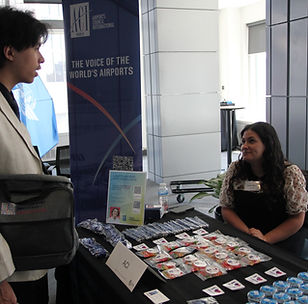
The career fair — kiosks staffed by aviation institutions, organizations and companies, including our partners. Each year, one participant leaves with an internship at Airbus and one with a traineeship at the European Commission, and ACI Global Training offers training vouchers to selected participants.
The networking workshop — a practical session taught by someone who does it for a living.
The receptions — a cocktail hosted by the Permanent Mission of Canada, another supported by Airbus. Same room as the ambassadors, glass in hand.
On the final day, the vote. Committees submit their commented resolutions, amendments are circulated, then everyone moves to the ICAO Council Chamber. The actual one. The resolutions negotiated all week are put to a vote — by placard, by roll call, or adopted by acclamation. What you voted on is a text you wrote. That is the point of the exercise. Resolutions adopted will be send to ICAO representatives.
The awards follow, then a closing cocktail, and the after-party — which is, officially, on the program.
What you leave with
-
A resolution you negotiated and had adopted, in an international organization’s Council Chamber
-
The habit of defending a position that is not your own, in two working languages
-
Contacts in ICAO, Airbus, ACI, the European Union and among the Member State representations and public and private organization
-
A line on your CV that very few students can write